
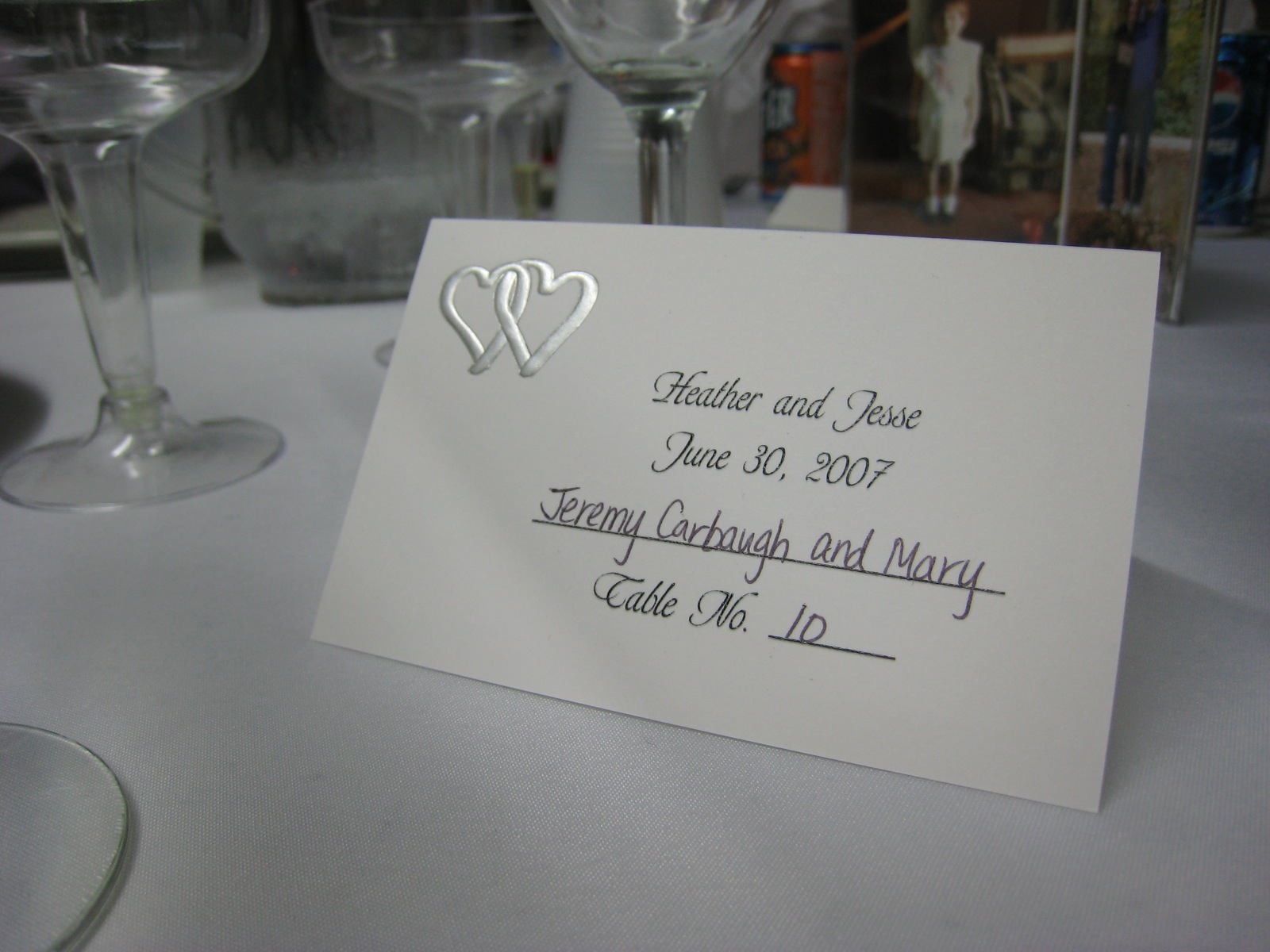
Escort cards look like a small detail, yet they decide how smoothly your guests move from the arrival area into the reception. Understanding what they are for makes every choice about them easier, and it matters just as much when guests are arriving in staggered groups from a limousine service.
- An escort card sends a guest to a table; a place card sends them to a seat.
- Full names, alphabetical order and a clear display keep the entrance moving.
- Sturdy paper and a final reprint window a few days before the wedding save last-minute stress.
What is an escort card, and how is it different from a place card?
The two are easy to confuse, and the confusion has a practical cost: if the cards are mixed up, guests bunch together at the entrance trying to work out where to go. The reasoning is simple. Each card answers a different question at a different moment of the evening.
It is displayed near the entrance of the reception space. A place card answers the question they ask second, once they reach the table: which seat is mine? It sits on the plate.
Many large weddings use both. Smaller gatherings sometimes use only one, and if you must choose, the escort card does more of the heavy lifting because it prevents the crowd at the door.
How should you lay out escort cards so guests find them quickly?
Guests do not read a display, they scan it. They are looking for one word, usually their surname, so your layout should reward that behavior.
- Print the full name on each escort card, since guests are scanning for a surname.
- Arrange the cards alphabetically, with the table number clearly visible on each one.
- Keep the display on a table near the entrance, where guests pass naturally as they arrive.
Why alphabetical order helps
When many guests arrive at the same moment, an alphabetical row lets several people search at once without asking anyone for help. A grouping by table looks tidy but forces everyone to find their name inside a block, which slows the line.
Place cards can be more casual
Once guests are already seated at the right table, first names are enough on place cards. The strict full-name rule belongs to the escort card, where the scanning happens.
What size and paper should you choose?
Size and weight are worth settling early, because they affect printing, display and how the cards survive being handled by a crowd.
The size most commonly used for escort cards is 3.5 by 2 inches when flat. Tented place cards start as 3.5 by 4 inches and fold down to the same 3.5 by 2. Using one size across both types keeps the look consistent.
For tented cards, choose heavy paper, at least 250 to 300 gsm. Lighter stock will not stand up on a plate and tends to curl or slump during the meal.
When you fold, score first. Press along the fold line with the back of a butter knife held against a ruler, then fold. Cardstock cracks if it is folded cold, and a scored line gives a clean edge.
How do place cards help with meal choices?
If your caterer serves plated meals with a choice, the kitchen and the servers need a reliable way to know who ordered what. A list handed to the head server works on paper but invites mistakes in a busy room.
A small symbol or color on the place card is the standard method. It travels with the guest, so any server can check it at a glance without consulting a sheet. Ask your caterer early how they prefer it to be marked, since they will usually have a system they trust.
This is another reason to keep escort cards and place cards distinct. The escort card gets the guest to the table, and the place card carries the detail that matters once the food arrives.
When should you print, and what if numbers change?
Timing is where most stress hides. Print too early and every late change means starting over. Print too late and you have no room for a misprint.
A sensible window is three to five days before the wedding, once final numbers are confirmed. Editable templates are useful here, because you can reprint a single card the night before if a guest drops out or a name turns out to be misspelled.
- Confirm the final guest list and seating plan first.
- Print a few spare blank cards for surprises.
- Check spelling of every name against the invitation list before printing.
Keep the finished cards in a flat box, in alphabetical order, so whoever sets up the display can place them without sorting at the venue.
Frequently asked questions
Do you need both escort cards and place cards?
Not always. Large weddings often use both, since one directs guests to a table and the other to a seat. For a smaller wedding, escort cards alone can be enough.
Should escort cards use first names or full names?
Use full names on escort cards, because guests scan for a surname. First names are fine on place cards, since the guest is already at the right table.
What paper weight works for tented cards?
Choose at least 250 to 300 gsm. Lighter paper will not stand up. Score the fold line before folding so the cardstock does not crack.
When should you print the cards?
Three to five days before the wedding is a good window, after final numbers are confirmed. That leaves time to reprint a single card if something changes.
Related reading
- Castle Wedding Venues: How to Choose One That Fits Your Day
- Wedding Champagne Glasses: Choosing the Right Flute for the Toast
Sources
- Wedding Place Cards & Escort Cards – Paper Goods Party (papergoodsparty.com, accessed 2026-11-23)
Photo: Place card-04, by Jeremy Carbaugh from Gaithersburg, MD, CC BY 2.0 (Wikimedia Commons)